Showing posts with label DNC hack. Show all posts

Thursday, August 4, 2016

Hey Everybody, David Klion Needs You to Panic about Russia Right Now--Before It's Too Late!

We're doomed. The neoliberal sky is falling, and the only thing that can keep you from being crushed by neoliberal debris is a neoliberal umbrella.

Yesterday, David Klion released a red-baiting screed entitled "Russia may be meddling in U.S. Politics. Where is the leftwing outrage?" through The Guardian. The purpose of the article is to convince readers that the only way they can protect themselves from the neoliberal corruption in Russia is to embrace the neoliberal fear mongering of the Democratic National Committee and their hired hands in the cybersecurity industry (CrowdStrike).

There are several laugh-out-loud paragraphs in Klion's piece, but the richest is probably this one:
[Contemporary Russia] is better understood as a cautionary tale of unchecked neoliberalism. The US-supported 1990s privatization schemes described in Naomi Klein’s The Shock Doctrine are directly responsible for the rise of Putin and the repressive state he presides over.
See that? Klion has to be a good guy because he knows to blame neoliberalism for bad things, such as Putin's authoritarianism.

But the neoliberalism of the DNC (whose spokespeople and cybersecurity experts are the only folks pushing the narrative that Russia is to blame for the leak) doesn't seem to trouble Klion at all.

Weird.

Klion's first paragraph acknowledges that we still don't know who hacked the DNC: "Russians may have hacked and leaked Democratic National Committee emails via WikiLeaks" (emphasis added). But Klion doesn't like to think in terms of maybe or maybe not. He wants to assume that what the DNC and CrowdStrike have said must be true and that anyone who fails to share his sense of alarm must be a closet Leninist:
[I]t was frustrating to watch many of my friends and allies on the left shrugging off concerns about Russia in my Twitter feed last week. Nearly a century after the Bolsheviks first seized power, the American left’s relationship with Russia is still defined by an abstract nostalgia for a failed socialist experiment that has little relevance today.
Klion carefully sidesteps the possibility that those of us who refuse to get caught up in his hysteria aren't so much waxing nostalgic for the days of "Uncle Joe" Stalin as we are deeply skeptical of claims made by the warmongering DNC and scare-and-sell cybersecurity tacticians:
To The Guardian's credit, it balanced Klion's red-baiting hysteria with a calmer, more reasonable piece by Trevor Timm entitled "The rush to blame Russia for the DNC email hack is premature."

So read the Timm piece if you want the boredom of feeling informed, but turn to Klion if you prefer the exhilaration of running around like a chicken with your head cut off.


Monday, August 1, 2016

Politifact Uses Sneaky Language (and Sneakier Punctuation) to Present Speculation as Fact in DNC Breach

Yesterday, Politifact's Lauren Carroll released an article entitled "What we know about Russia's role in the DNC email leak." The purpose of the article is to make speculation seem more factual than it is.

Carroll is an artful writer who knows how to create the illusion of objectivity by placing almost all (but not quite all) of her quoted material within quotation marks. She also understands how balanced it makes her article seem for her to begin and end with arguments (one from Julian Assange and the other from Jeffrey Carr) that challenge its preconceived conclusion.

Carroll certainly seems meticulous in the presentation of her evidence with paragraphs such as this one:
"The consensus that Russia hacked the DNC is at this point, very strong, albeit not unanimous," said cybersecurity consultant Matt Tait, who has been critical of Clinton's email practices. "The consensus that Russia hacked the DNC in support of Trump is, by contrast, plausible, but something for which the jury at this stage is very much still out."
Did you notice all the signifiers of non-partisan objectivity? First, Tait is no shameless Clinton surrogate, since he dares to be critical of her patently careless email practices. Second, he admits that the consensus about Russia's guilt isn't unanimous. And third, he is positively eager to concede the point that even if Russia is responsible for the DNC breach, that doesn't mean the purpose of the hack was to support Trump in the election (which suggests that asking "Have you stopped beating your wife?" is more reasonable than asking "Have you stopped beating your wife for her bad singing voice?" because the former question doesn't foreclose possible answers with as much specificity as the latter).

Caroll is equally artful in her construction of this paragraph:
The U.S. government is not ready to publicly name the suspected perpetrators behind the DNC hack, but the New York Times has reported that intelligence agencies have "high confidence" regarding the Russian government's involvement.
See what she did there? She's a responsible journalist who recognizes and maintains distinctions between the accusations of private cybersecurity companies (such as CrowdStrike) and the findings of official government intelligence agencies. But she also wants her readers to know that even though she can't say the U.S. government blames Russia for the attack, the New York Times says it (which is analogous to the argument that Clinton campaign chairman Robby Mook used to support his redbaiting analysis of the breach on CNN on July 24th: "This isn't my assertion; there are a number of experts that are asserting this").

However, Carroll is at her most artful not when she couches quotations in slanted ways, but when she eschews quotation marks entirely so as to blur her own voice (the voice of a presumably disinterested journalist) with the voice of her interviewees (some of whom are shameless partisan shills):
Translation: The agencies have likely corroborated the technical evidence with other intelligence, like human or financial sources, said Susan Hennessey, a Brookings Institution fellow and a former lawyer for the National Security Agency.
As of yet, there’s no evidence anyone other than Russia breached the DNC. So unless someone hacked the Russian agencies, the Russian government is likely WikiLeaks’ source, Hennessey said. Additionally, Assange and the Russian government have a well-documented relationship, for example the fact that Assange has hosted a television show on RT, a state-owned network. [Emphasis added.]
Just look at the first sentence of that second paragraph (the one in bold type), and ask yourself what effect it's likely to have on most readers skimming through the article. It completely dispenses with the question of whether Russia is behind the DNC breach by wondering only whether any other entities might also have participated. And the absence of quotation marks doesn't even warn readers that the incredibly lazy logic of such an argument belongs to Susan Hennessey rather than Lauren Carroll--not until they reach the end of the next sentence (which some skimmers never do).

The most positive thing I can say about Carroll's article is that it at least mentions Jeffrey Carr, whose "Can Facts Slow The DNC Breach Runaway Train?" is the single most cogent analysis of the DNC breach written from the perspective of someone with the relevant technological expertise.

I can't say the Politifact article is bad because it's actually a brilliant example of propaganda. Carroll has chops as a writer; she knows better than to try to jam an argument down her readers' throats without first coating it in FD&C Yellow #34 (a synthetic coloring and flavorizer designed by muckrakers to make arguments taste more objective than they are). So read the Politifact article if you want to know what the corporate media wants you to think about the DNC breach.

But read Carr's article if you want reasoned, relevant analysis.


Monday, July 18, 2016

The DNC Has "Deployed the Recommended" to Deal with Guccifer 2.0--Whatever That Means

Joe Uchill of The Hill has written three articles about Guccifer 2.0 since July 13th. All three conclude in much the same way (by reminding readers that unidentified sources consider Guccifer 2.0 to be part of a Russian disinformation campaign).

Here's the final paragraph of "Guccifer 2.0 releases new docs" (7/13):
“Our experts are confident in their assessment that the Russian government hackers were the actors responsible for the breach detected in April, and we believe that the subsequent release and the claims around it may be a part of a disinformation campaign by the Russians,” a senior DNC official said in a written statement.
Here's the antepenultimate paragraph of "Celeb phone numbers included in Guccifer 2.0 hack" (7/18):
Many have suggested that Guccifer 2.0 is a front for Vladimir Putin in the Russian leader’s efforts to influence American politics, something Guccifer 2.0 denies.
And here are the final two paragraphs of "New Guccifer 2.0 dump highlights 'wobbly Dems' on Iran deal" (7/18):
The DNC declined to issue a new comment but reiterated a prior statement from a senior official.

“Our experts are confident in their assessment that the Russian government hackers were the actors responsible for the breach detected in April,” that statement read, “and we believe that the subsequent release and the claims around it may be a part of a disinformation campaign by the Russians. We’ve deployed the recommended.”
Note that the last conclusion is almost identical to the first. However, Uchill knows better than to conclude two out of three articles on the same subject in less than a week in exactly the same way. So he presents the illusion of changing things up by moving the attribution of his unnamed source to the middle of the paragraph and tacking on a puzzling piece of extra information: "We've deployed the recommended."

The recommended what? It seems as though the article ends on a challenge to the reader to fill in the blank--something that's very easy to do if we remember one of Guccifer 2.0's earlier leaks concerning "Reporter Outreach" strategies from the DNC: "pitch stories with no fingerprints and utilize reporters to drive a message."

I therefore suspect that if Uchill had included the final sentence of his latest conclusion in full, it would have read something like this: "We've deployed the recommended strategy of ensuring that reporters muddy the waters around Guccifer 2.0 by concluding every single article they write about the hacker with speculation about his being part of a Russian disinformation campaign."


Wednesday, July 13, 2016

The Hill Releases a New Guccifer 2.0 Leak According to the Same Old Formula

Earlier today, The Hill published an article concerning the latest leak from Guccifer 2.0. The article is fourteen paragraphs long--and every bit as formulaic as a sonnet (albeit without the rhyme scheme).

Instead of arguing that the media routinely compartmentalizes and marginalizes all substantive discussion of Guccifer 2.0, I'll let a paragraph-by-paragraph summary of this article make that argument for me.

***

Paragraph 1: There's a new leak from Guccifer 2.0

Paragraph 2: The leak includes information concerning two Democratic donors and research on one prominent Republican (Sarah Palin).

Paragraph 3: Guccifer 2.0 was motivated to share this data with The Hill because WikiLeaks is dragging its feet and the press is no longer paying much attention to the DNC breach.

Paragraph 4: Even though the new leak provides interesting information about the DNC, The Hill is far more interested in what it reveals about Guccifer 2.0. Read it yourself:
The documents provide some insight into how the DNC handled high-profile donation scandals. But the choice of documents revealed to The Hill also provides insight into the enigmatic Guccifer 2.0.
Paragraph 5: The Democrats don't want candidates associated with donor Norman Hsu to be contaminated by the scandal that led to Hsu's conviction and sentencing in 2009.

Paragraph 6: Lobbyist Paul J. Magliocchetti is a known associate of Representative John Murtha (a Pennsylvania Democrat), but since Magliocchetti pleaded guilty to campaign finance charges in 2010, the important thing to remember is that he also donated to a lot of Republicans.

Paragraph 7: The scandals surrounding Hsu and Magliocchetti are both really old, so it seems strange that a lone Romanian hacker would have had the intimate knowledge of American politics necessary to understand the importance of sharing those two particular items with The Hill.

Paragraph 8: Guccifer 2.0 probably isn't who he says because his tools "were matched to Russian intelligence agencies" and because the hacker "struggled to speak in Romanian."

Paragraph 9: Some people (no one mentioned by name) think Russians are behind the hack, but others (Donald Trump singled out for attention) think the hack is a "false flag" operation run by the DNC.

Paragraph 10: Guccifer 2.0 came out of nowhere.

Paragraph 11: The Guccifer 2.0 moniker is an homage to Guccifer, the Romanian hacker who, according to FBI Director James Comey, lied about hacking into the clintonemail.com server.

Paragraph 12: The DNC collected a bunch of silly things Sarah Palin said and wrote, and Guccifer 2.0 handed those things over to The Hill.

Paragraph 13: The Hill also received a 10,000-name database from Guccifer 2.0, along with some other donor data.

Paragraph 14: The DNC remains confident that Russians are behind the breach, according to an unnamed senior official who is apparently relying on the pronouncement of unnamed "experts."

***

See how that works? Of fourteen paragraphs, only five (the second, fifth, sixth, twelfth, and thirteenth) concern the leaked materials.

And how strange that the longest paragraph by far (the eleventh, which is 50% longer than any other paragraph in the piece) is more focused on Guccifer than on Guccifer 2.0.

But the most troubling paragraph from my perspective is the eighth, which sins twice in three short lines. It begins by failing to identify the DNC's hired cybersecurity company (CrowdStrike) as the agency responsible for matching the hacker's tools to those of "Russian intelligence agencies." Then, without even stopping to wonder why there are two competing stories of how Guccifer 2.0 accessed the DNC network (a zeroday exploit of NGP VAN vs. a spear phishing campaign via Gmail), writer Joe Uchill goes on to assert that Guccifer 2.0 doesn't "speak" Romanian well. That assertion is presumably based on Motherboard's linguistic analysis of typed responses from Guccifer 2.0 to questions posed to him in Romanian, English, and Russian.

The Motherboard article features remarks from an expert in "Slavic syntax" who is skeptical about Guccifer 2.0's native language because of the way the hacker uses and misuses definite and indefinite articles. Unfortunately, no one can ask this linguist for further details because s/he preferred to "remain anonymous"--since we all know about the severe repercussions people face when they opine publicly about definite articles. The Motherboard piece goes on to point out that Guccifer 2.0's expertise in Romanian is questionable because he sometimes misused diacritics in his typed responses, as when he wrote "limbă" where the typical Romanian would have written plain "limba."

It's especially funny that The Hill relies on this weak argument in the context of an article that fails to double the 't' in "forgetting" (paragraph 3) and omits the 'i' from "paired" (paragraph 13). Since Americans ordinarily don't make such mistakes, The Hill plainly needs to investigate this Uchill fellow to make sure he isn't a Romanian spy.

Of course, the paragraph that should trouble me most is the fourteenth, in which Uchill drags the Russians back into the story despite having last touched on them five paragraphs earlier. But those of us who are following the Guccifer 2.0 story have come to expect articles to end on such non sequiturs. The point of these stories is almost invariably to lead readers to the conclusion that Guccifer 2.0 is probably a Russian operative, and the easiest way to imbue a shaky conclusion with a sense of finality is to place it at the end of an article--as Uchill does.


Tuesday, July 5, 2016

Guccifer Vs. Guccifer 2.0

Earlier today, FBI Director James Comey held a press conference concerning his decision not to recommend prosecution of Hillary Clinton for her use of a private email server.

During his statement to the press, Comey indicated that there was no evidence that Clinton's server had been "successfully hacked."

The #Guccifer2 hashtag on Twitter soon exploded with a number of puzzling claims akin to this:


It's been clear for weeks now that only a fraction of the U.S. population is following the Guccifer 2.0 story. Today, however, it became clear that even those who are following Guccifer 2.0 have blurred distinctions between this new hacker and his namesake.

For the key differences between the original Guccifer and Guccifer 2.0, let's review some basic facts, some reasonable inferences, and some conjectures.

Facts about Guccifer

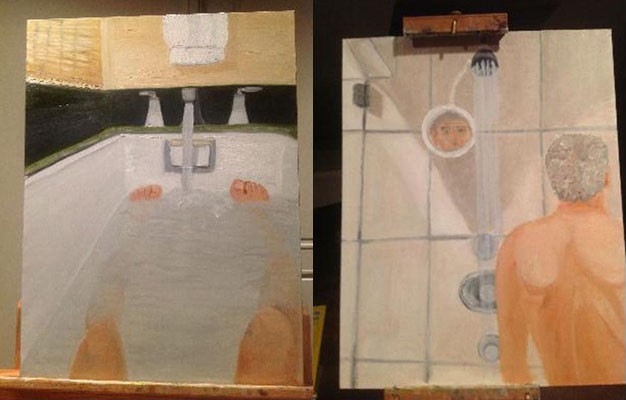
We know who the original Guccifer is. He's a Romanian hacker named Marcel Lazar Lehel who first gained notoriety in 2013 by revealing some weird (not unsettling, just naif) paintings done by former President George W. Bush. The images were included in an email Bush sent his sister Dorothy, whose email account Guccifer had hacked.


Lehel subsequently hacked the AOL account of Clinton crony Sidney Blumenthal and found emails from Blumenthal to Hillary Clinton at her clintonemail.com email account. Clinton's decision to rely on a private server for her email (rather than her government-issued state.gov account) received some attention in the press before getting lost in the haze of the Benghazi controversy--reemerging two years later when the New York Times reported on the consternation that Clinton's unorthodox record-keeping arrangements had caused officials at the National Archives and Records Administration. 

Although Lehel claimed to have accessed Clinton's private server (famously remarking that it was "like an open orchid on the internet"), no proof that he did so has been released to the public. We know he's a hacker who is capable of accessing the data of high-profile politicians (Bush) and that he discovered the existence of the clintonemail.com server before the general public knew about it, but he may be lying about having breached that server.

Facts about Guccifer 2.0

We do not know who Guccifer 2.0 is. He claims to be a lone male Romanian hacker who chose his moniker as an homage to Lehel, but Guccifer 2.0 may not be Romanian or male or even necessarily an individual human being. Whatever the identity of Guccifer 2.0 really is, he communicates with the public via his Twitter account (@Guccifer_2) and by periodically uploading documents (ostensibly stolen from the Democratic National Committee) to his blog.

The DNC has yet to confirm that the documents on the Guccifer 2.0 blog are authentic, but the blog itself definitely exists--with more hacked documents expected to appear today.

Whether the operator of the @Guccifer_2 Twitter account is really a male Romanian hacker or not, there's definitely someone there, as I have engaged in multiple DM exchanges with that entity (none of them very satisfying to my curiosity, regrettably).

Unlike Lehel, Guccifer 2.0 does not claim to have hacked the clintonemail.com server, though he does claim to have been inside the DNC network for "almost a year."

Reasonable Inferences about Guccifer

In his statement this morning, Comey acknowledged that even though the clintonemail.com server might have been breached by hackers who left no trace, the FBI found no evidence of a successful hack. So maybe Guccifer is lying about his access to the server--or maybe the FBI is lying about Guccifer's access.

It's reasonable to wonder as long as one doesn't wonder too hard--since one quickly ends up speculating about FBI speculation.

Reasonable inferences can quickly deteriorate into conspiratorial fantasy with a little help from unreliable sources such as Sorcha Faal, who contended (in an article for WhatDoesItMean.com) that Lehel recently escaped from prison. This sensational claim was debunked earlier today by a Snopes article whose author verified that the original Guccifer is "alive, well, and in custody" in the Virginia prison where he is supposed to be.

Reasonable Inferences about Guccifer 2.0

The fact that the DNC has yet to deny the authenticity of the materials on the Guccifer 2.0 blog suggests that those materials really do come from the DNC.

But even if the materials are genuine, that doesn't prove they were hacked. The data Guccifer 2.0 has exposed to the public has not been especially damaging to Clinton, and much of it (such as the negative press coverage of Donald Trump in what appears to be a genuine opposition report) is common knowledge.

People talk about the DNC hack as if it undoubtedly occurred, but the evidence is hardly conclusive. Those who accept the hack as an unquestionable part of reality do so because 1) the DNC claimed it happened, 2) the cybersecurity firm they hired repeated the claim, and 3) an unidentified source with access to Wordpress and Twitter claims to have been responsible for the breach.

Although the evidence that a DNC data breach occurred is substantial enough to make the hack more likely than not, we should remember that if hacks can occur, they can also be faked.

Conjectures about Guccifer

The most reasonable conjecture I've seen about Lehel is that hackers who seek notoriety often exaggerate their expertise--and that his claim to have had easy access to the clintonemail.com server was probably a bid for attention.

The most outrageous claim I've encountered about Lehel is that he was squirreled away on Loretta Lynch's private plane for the Phoenix Sky Harbor International Airport meeting between Lynch and Bill Clinton.

I can't prove or disprove either claim. Maybe you know something I don't.

Conjectures about Guccifer 2.0

The most reasonable conjecture I've encountered about Guccifer 2.0 is that he probably isn't who he claims to be. Most hackers must conceal their identities to survive and achieve their objectives.

The most outrageous claim that I've seen about Guccifer 2.0 is that he is part of a coordinated disinformation campaign managed by Russian intelligence agencies. This claim (first floated by CrowdStrike in mid-June) remains commonplace even though it's unclear how Russia is better off creating a digital persona that could still conceivably be traced back to governmental operatives instead of relying on the outright denail they already issued. (When it comes to disinformation campaigns, denials are much less expensive and troublesome than the concoction of cyberpersonae.)

I can't prove or disprove either claim. Maybe you know something I don't.