Wednesday, July 13, 2016

The Hill Releases a New Guccifer 2.0 Leak According to the Same Old Formula

Earlier today, The Hill published an article concerning the latest leak from Guccifer 2.0. The article is fourteen paragraphs long--and every bit as formulaic as a sonnet (albeit without the rhyme scheme).

Instead of arguing that the media routinely compartmentalizes and marginalizes all substantive discussion of Guccifer 2.0, I'll let a paragraph-by-paragraph summary of this article make that argument for me.

***

Paragraph 1: There's a new leak from Guccifer 2.0

Paragraph 2: The leak includes information concerning two Democratic donors and research on one prominent Republican (Sarah Palin).

Paragraph 3: Guccifer 2.0 was motivated to share this data with The Hill because WikiLeaks is dragging its feet and the press is no longer paying much attention to the DNC breach.

Paragraph 4: Even though the new leak provides interesting information about the DNC, The Hill is far more interested in what it reveals about Guccifer 2.0. Read it yourself:
The documents provide some insight into how the DNC handled high-profile donation scandals. But the choice of documents revealed to The Hill also provides insight into the enigmatic Guccifer 2.0.
Paragraph 5: The Democrats don't want candidates associated with donor Norman Hsu to be contaminated by the scandal that led to Hsu's conviction and sentencing in 2009.

Paragraph 6: Lobbyist Paul J. Magliocchetti is a known associate of Representative John Murtha (a Pennsylvania Democrat), but since Magliocchetti pleaded guilty to campaign finance charges in 2010, the important thing to remember is that he also donated to a lot of Republicans.

Paragraph 7: The scandals surrounding Hsu and Magliocchetti are both really old, so it seems strange that a lone Romanian hacker would have had the intimate knowledge of American politics necessary to understand the importance of sharing those two particular items with The Hill.

Paragraph 8: Guccifer 2.0 probably isn't who he says because his tools "were matched to Russian intelligence agencies" and because the hacker "struggled to speak in Romanian."

Paragraph 9: Some people (no one mentioned by name) think Russians are behind the hack, but others (Donald Trump singled out for attention) think the hack is a "false flag" operation run by the DNC.

Paragraph 10: Guccifer 2.0 came out of nowhere.

Paragraph 11: The Guccifer 2.0 moniker is an homage to Guccifer, the Romanian hacker who, according to FBI Director James Comey, lied about hacking into the clintonemail.com server.

Paragraph 12: The DNC collected a bunch of silly things Sarah Palin said and wrote, and Guccifer 2.0 handed those things over to The Hill.

Paragraph 13: The Hill also received a 10,000-name database from Guccifer 2.0, along with some other donor data.

Paragraph 14: The DNC remains confident that Russians are behind the breach, according to an unnamed senior official who is apparently relying on the pronouncement of unnamed "experts."

***

See how that works? Of fourteen paragraphs, only five (the second, fifth, sixth, twelfth, and thirteenth) concern the leaked materials.

And how strange that the longest paragraph by far (the eleventh, which is 50% longer than any other paragraph in the piece) is more focused on Guccifer than on Guccifer 2.0.

But the most troubling paragraph from my perspective is the eighth, which sins twice in three short lines. It begins by failing to identify the DNC's hired cybersecurity company (CrowdStrike) as the agency responsible for matching the hacker's tools to those of "Russian intelligence agencies." Then, without even stopping to wonder why there are two competing stories of how Guccifer 2.0 accessed the DNC network (a zeroday exploit of NGP VAN vs. a spear phishing campaign via Gmail), writer Joe Uchill goes on to assert that Guccifer 2.0 doesn't "speak" Romanian well. That assertion is presumably based on Motherboard's linguistic analysis of typed responses from Guccifer 2.0 to questions posed to him in Romanian, English, and Russian.

The Motherboard article features remarks from an expert in "Slavic syntax" who is skeptical about Guccifer 2.0's native language because of the way the hacker uses and misuses definite and indefinite articles. Unfortunately, no one can ask this linguist for further details because s/he preferred to "remain anonymous"--since we all know about the severe repercussions people face when they opine publicly about definite articles. The Motherboard piece goes on to point out that Guccifer 2.0's expertise in Romanian is questionable because he sometimes misused diacritics in his typed responses, as when he wrote "limbă" where the typical Romanian would have written plain "limba."

It's especially funny that The Hill relies on this weak argument in the context of an article that fails to double the 't' in "forgetting" (paragraph 3) and omits the 'i' from "paired" (paragraph 13). Since Americans ordinarily don't make such mistakes, The Hill plainly needs to investigate this Uchill fellow to make sure he isn't a Romanian spy.

Of course, the paragraph that should trouble me most is the fourteenth, in which Uchill drags the Russians back into the story despite having last touched on them five paragraphs earlier. But those of us who are following the Guccifer 2.0 story have come to expect articles to end on such non sequiturs. The point of these stories is almost invariably to lead readers to the conclusion that Guccifer 2.0 is probably a Russian operative, and the easiest way to imbue a shaky conclusion with a sense of finality is to place it at the end of an article--as Uchill does.

Tuesday, July 12, 2016

H.A. Goodman's Desperation Is Showing

I didn't cry foul back in May when H. A. Goodman released a video entitled "FBI Will Recommend Indictment of Hillary Clinton Soon." I didn't need to say anything. Plenty of people offered uncharitable criticisms of the piece based on weak arguments (e.g. nobody can predict the future) and strong arguments (e.g. Hillary Clinton can't be indicted because she is above the law). Besides, I decided to construe that title charitably--as a rhetorical counter-punch to equally polemical and misguided headlines from Goodman's colleagues at The Huffington Post, such as Vincent Intondi's "No, Hillary Clinton Is Not Worse Than Donald Trump" in March.

In fact, I thought there was a strong case to be made for the hyperbolic headlines that Goodman relied on throughout the primary (from "Hillary Clinton Should Concede to Bernie Sanders Before the FBI Reveals Its Findings" to "Yes, Bernie Sanders Will Win the Contested Convention"). The corporate media's campaign of condescension towards Sanders for the past year has been so suffocating that Goodman's headlines could reasonably be interpreted as crude but necessary skewers meant to poke holes in the airtight narrative of Clinton's inevitability.

Even those of us who found Goodman's arguments poorly researched (as when he condemned a Clinton endorsement by "Ms." Jann Wenner of Rolling Stone--subsequently corrected) or soul-crushingly repetitive (indictment take #1, indictment take #16, indictment take #116 )--even we understood that Goodman was playing the role of a motivational speaker rather than a journalist. For many Sanders supporters who felt betrayed by every media outlet from NPR to the New York Times, Goodman's arguments didn't need to be compelling as long as they were sufficiently uplifting.

Goodman's fans believe he speaks truth to power. But now that he can no longer bludgeon the Clinton camp with a looming FBI indictment, it's plain that power shouldn't listen to him because he doesn't know enough about the 2016 election to speak the truth, as he demonstrated in this interview with Tim Black:


Even though Goodman has long championed the Bernie-or-bust movement, with its focus on either writing in Bernie Sanders or voting for the Green Party's Jill Stein in November, he clearly considers Stein a tool that can best be used to threaten the Democratic Party--especially by those disinclined to dwell on policy particulars. Goodman doesn't appear to have an opinion about (or an awareness of) substantive differences between Stein and Sanders beyond their personal stances on drones and their parties' stances on Black Lives Matter.

At the thirty-minute mark, Black gave Goodman the opportunity to spew a bunch of misinformation about Gary Johnson. Goodman obliged by telling Black's viewership that the Libertarian Party opposes the Trans-Pacific Partnership and champions Wall Street regulation (which comes as a surprise, I suspect, to many Libertarians). Contrary to Goodman's claim, Johnson is an avowed proponent of the TPP, as he reiterated in a CNN interview just last weekend: "I'm being told that the Trans-Pacific Partnership would, in fact, advance free trade, and so I would support that document."

Of the five most important candidates (Clinton, Trump, Sanders, Stein, and Johnson), Johnson is the only one who is showing overt support for the TPP at this point in the campaign cycle--a fact worthy of attention for anyone paying attention (and especially those being paid to pay attention). Clinton knows she has to lie about her support of the TPP until she gets into office; Trump knows he needs to pretend to be outraged by it to authenticate himself as a populist; and Sanders and Stein both genuinely oppose it. But Johnson doesn't even feel compelled to lie about his support for the deal--apparently because he can count on people like Goodman not to hold his own words against him.

The problems aren't confined to Goodman's flawed and superficial understanding of third-party candidates. Earlier in the interview (at around 21:10), Goodman deliberately distorted FBI Director James Comey's remarks about Hillary Clinton's carelessness with classified information. According to Goodman, Comey conceded that people responsible for less significant security breaches than Clinton had been jailed for their offenses. While it's true that others have faced criminal charges for lesser offenses, that isn't at all what Comey conceded when he remarked:
To be clear, this is not to suggest that in similar circumstances, a person who engaged in this activity would face no consequences. To the contrary, those individuals are often subject to security or administrative sanctions. But that is not what we are deciding now.
This concession from Comey has nothing whatever to do with the criminality of Clinton's actions and everything to do with how security breaches in various government departments routinely result in demotions, firings, or the revocation of security clearances--but Goodman is only interested in what he wanted to hear, not what Comey said.

There may have been a time when Goodman's insistence on seeing the world through rose-tinted glasses was helpful (or perhaps even emotionally necessary) for some Sanders supporters, but that time has passed. Despite all the setbacks we've experienced, we must recognize that no matter how painful things are right now, sobriety and honesty are much more effective tools for moving us forward than ignorance and fantasy.


Friday, July 8, 2016

Donald Trump Knows How to Be a Heel; Hillary Clinton Has No Clue How to Be a Face

No pollster, historian, or political scientist has ever offered as succinct and accurate a definition of American politics as the one attributed to musician Frank Zappa: "Politics is the entertainment division of the military-industrial complex." Perhaps it should come as no surprise that it took an entertainer to see our political system for what it is.

Neither should it surprise us that people with experience in the wrestling world (such as Jesse "The Body" Ventura and Donald "The People's Billionaire" Trump) are capable of translating that experience to success in politics.

Professional wrestling does something that all political parties attempt to do by creating a contest between a face (the good guy) and a heel (the bad guy). Before the 2016 election, however, the job of the two major political parties has been to depict their own nominees as faces and their opponents as heels.

Things are different in 2016 because the Democrats and Republicans seem to agree about who the face is (Hillary Clinton) and who the heel is (Donald Trump).

Establishment Democrats and establishment Republicans are essentially united in their support of Hillary Clinton. They can all see plainly that she's the more "presidential" candidate--so why can't the voters see it?

Why can't the voters understand that even though neither Trump nor Clinton will lift a finger as President to curtail police shootings of civilians (especially people of color), Clinton will be at least as effective as Obama when it comes to bemoaning such events as tragic?

Why can't the voters understand that even though both Trump and Clinton are lying about their opposition to the TPP, Clinton will do a better job than Trump of convincing voters, once she's in office, that it's a good idea to make our regulatory procedures subject to corporate oversight because the only way to save the American economy is by killing American democracy?

Why can't the voters understand that since the atmosphere is going to choke on carbon emissions anyway, Clinton will do a much better job than Trump of making people all over the world feel optimistic about the business opportunities associated with climate change?

Why can't the voters understand that it takes a delicate touch to use the U.S. alliance with Israel to simultaneously provoke war with Russia and Iran--and that Clinton has spent her political career developing the fine motor skills in the diplomatic fingers necessary to execute that maneuver, whereas Trump will probably bungle things and only end up going to war with one country or the other?

The answer is too simple for political pundits to understand, but right up the alley of wrestling afficianados.

The fact of the matter is that Trump has held up his end of the bargain. He has "gone over" as a heel--to the point that when people ask if Trump is serious about becoming president, his most vocal supporter in the media (Roger Stone) can get away with saying he's "fairly certain" Trump would serve as President if he were to win the election.

"Fairly certain"? C'mon now--if that isn't a guy from the crowd charging into the ring to break a chair over the head of a wrestler, what is it?

And what about yesterday's story that Trump's daughter Ivanka is under consideration as a vice-presidential candidate? That's right out of heel shenanigans 101--designed to get some folks in the audience to ooh and aah while most of the people around them boo.

Trump's longstanding relationship with Vince McMahon (of World Wrestling Entertainment) was mutually beneficial because Trump got to be in the limelight and McMahon got the services of a man who has an instinct for doing whatever it takes to go over with crowds.

But Hillary Clinton has no such instinct. She has never gone over as a face--not even in her unelected position as First Lady. There's nothing surprising about a face claiming to stand up for the rights of women and children, but it isn't enough to make the claim. Real faces--successful faces--manage to convince their audiences that they have a natural instinct to stand up for the helpless (which is difficult for Clinton to do with Marian Wright Edelman exposing Clinton's cynical reliance on her own ties to the Children's Defense Fund to sidestep criticisms that she and Bill have done more to harm vulnerable communities of color in our nation than any other couple in history--including Ronald and Nancy Reagan).

Hillary Clinton didn't go over as a face in Berta Caceres' opinion. She isn't a lovable champion of human rights in the minds of Syrians caught up in a disastrous diaspora. She didn't charm minimum wage workers in New York by refusing to support the fight for $15 until it was over.

It's time for the establishment to stop blaming voters for Clinton's failure to go over as a face.

Sure, wrestlers who are despicable human beings can come across as faces within the tightly scripted and confined world of the WWE. That's because the version of the wrestler that the WWE shows us is the only one we get to see.

But no matter how many staffers Clinton hires, she can't keep her public life as scripted and confined as is necessary for her claims of faceness to ring true. We see her for the heel that she is.

That's why it's starting to look like she'll lose to Donald Trump no matter how hard he tries to throw the match to her.


Thursday, July 7, 2016

According to James Comey, Guccifer Lied about Accessing the Clintonemail.com Server

As I indicated in a previous post, we never had proof that Marcel Lazar Lehel (Guccifer) had breached the clintonemail.com server.

In a statement today, FBI Director James Comey claimed that Lehel admitted to the FBI that he was lying about having accessed the clintonemail.com server.

Whether Lehel ever made such an admission or not is irrelevant to this post. (I have no way of knowing whether Lehel lied to the FBI or whether the FBI is lying about what he said.)

The point of this post is to report on the state of the #Guccifer2 hashtag on Twitter following Comey's revelation.

Social media users overwhelmingly fail to appreciate that even if Guccifer did admit that he lied about accessing clintonemail.com, that has nothing whatsoever to do with the authenticity of the DNC documents leaked by Guccifer 2.0.
The fact that the distinction between Guccifer and Guccifer 2.0 is lost on much of the public suggests something about how little attention people are paying to the DNC hack--but it suggests far more about how little coverage the Guccifer 2.0 revelations have received from corporate media.

Earlier this week, Twitter was abuzz with rumors that Guccifer 2.0 had been found dead in his jail cell (which is impossible, since he remains at large--unlike Lehel, whose death was the subject of a debunked story).

Today, Twitter is abuzz again with assertions that the DNC hack must not be authentic because Marcel Lehel lied about accessing clintonemail.com. Even people who understand that the Guccifers are different hackers still blur the two hacks based on Comey's statement:
How strange that people who have no trouble understanding the difference between George H.W. Bush and George W. Bush somehow fail to grasp the difference between Marcel Lazar Lehel (Guccifer) and the unidentified hacker whose handle (Guccifer 2.0) is an homage to Lehel.

Might that be because the Guccifer 2.0 story has been almost entirely ignored by televised corporate news?

I think it might.


Tuesday, July 5, 2016

Guccifer Vs. Guccifer 2.0

Earlier today, FBI Director James Comey held a press conference concerning his decision not to recommend prosecution of Hillary Clinton for her use of a private email server.

During his statement to the press, Comey indicated that there was no evidence that Clinton's server had been "successfully hacked."

The #Guccifer2 hashtag on Twitter soon exploded with a number of puzzling claims akin to this:


It's been clear for weeks now that only a fraction of the U.S. population is following the Guccifer 2.0 story. Today, however, it became clear that even those who are following Guccifer 2.0 have blurred distinctions between this new hacker and his namesake.

For the key differences between the original Guccifer and Guccifer 2.0, let's review some basic facts, some reasonable inferences, and some conjectures.

Facts about Guccifer

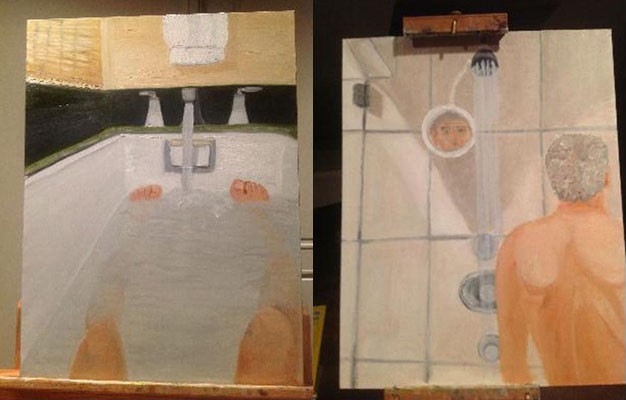
We know who the original Guccifer is. He's a Romanian hacker named Marcel Lazar Lehel who first gained notoriety in 2013 by revealing some weird (not unsettling, just naif) paintings done by former President George W. Bush. The images were included in an email Bush sent his sister Dorothy, whose email account Guccifer had hacked.


Lehel subsequently hacked the AOL account of Clinton crony Sidney Blumenthal and found emails from Blumenthal to Hillary Clinton at her clintonemail.com email account. Clinton's decision to rely on a private server for her email (rather than her government-issued state.gov account) received some attention in the press before getting lost in the haze of the Benghazi controversy--reemerging two years later when the New York Times reported on the consternation that Clinton's unorthodox record-keeping arrangements had caused officials at the National Archives and Records Administration. 

Although Lehel claimed to have accessed Clinton's private server (famously remarking that it was "like an open orchid on the internet"), no proof that he did so has been released to the public. We know he's a hacker who is capable of accessing the data of high-profile politicians (Bush) and that he discovered the existence of the clintonemail.com server before the general public knew about it, but he may be lying about having breached that server.

Facts about Guccifer 2.0

We do not know who Guccifer 2.0 is. He claims to be a lone male Romanian hacker who chose his moniker as an homage to Lehel, but Guccifer 2.0 may not be Romanian or male or even necessarily an individual human being. Whatever the identity of Guccifer 2.0 really is, he communicates with the public via his Twitter account (@Guccifer_2) and by periodically uploading documents (ostensibly stolen from the Democratic National Committee) to his blog.

The DNC has yet to confirm that the documents on the Guccifer 2.0 blog are authentic, but the blog itself definitely exists--with more hacked documents expected to appear today.

Whether the operator of the @Guccifer_2 Twitter account is really a male Romanian hacker or not, there's definitely someone there, as I have engaged in multiple DM exchanges with that entity (none of them very satisfying to my curiosity, regrettably).

Unlike Lehel, Guccifer 2.0 does not claim to have hacked the clintonemail.com server, though he does claim to have been inside the DNC network for "almost a year."

Reasonable Inferences about Guccifer

In his statement this morning, Comey acknowledged that even though the clintonemail.com server might have been breached by hackers who left no trace, the FBI found no evidence of a successful hack. So maybe Guccifer is lying about his access to the server--or maybe the FBI is lying about Guccifer's access.

It's reasonable to wonder as long as one doesn't wonder too hard--since one quickly ends up speculating about FBI speculation.

Reasonable inferences can quickly deteriorate into conspiratorial fantasy with a little help from unreliable sources such as Sorcha Faal, who contended (in an article for WhatDoesItMean.com) that Lehel recently escaped from prison. This sensational claim was debunked earlier today by a Snopes article whose author verified that the original Guccifer is "alive, well, and in custody" in the Virginia prison where he is supposed to be.

Reasonable Inferences about Guccifer 2.0

The fact that the DNC has yet to deny the authenticity of the materials on the Guccifer 2.0 blog suggests that those materials really do come from the DNC.

But even if the materials are genuine, that doesn't prove they were hacked. The data Guccifer 2.0 has exposed to the public has not been especially damaging to Clinton, and much of it (such as the negative press coverage of Donald Trump in what appears to be a genuine opposition report) is common knowledge.

People talk about the DNC hack as if it undoubtedly occurred, but the evidence is hardly conclusive. Those who accept the hack as an unquestionable part of reality do so because 1) the DNC claimed it happened, 2) the cybersecurity firm they hired repeated the claim, and 3) an unidentified source with access to Wordpress and Twitter claims to have been responsible for the breach.

Although the evidence that a DNC data breach occurred is substantial enough to make the hack more likely than not, we should remember that if hacks can occur, they can also be faked.

Conjectures about Guccifer

The most reasonable conjecture I've seen about Lehel is that hackers who seek notoriety often exaggerate their expertise--and that his claim to have had easy access to the clintonemail.com server was probably a bid for attention.

The most outrageous claim I've encountered about Lehel is that he was squirreled away on Loretta Lynch's private plane for the Phoenix Sky Harbor International Airport meeting between Lynch and Bill Clinton.

I can't prove or disprove either claim. Maybe you know something I don't.

Conjectures about Guccifer 2.0

The most reasonable conjecture I've encountered about Guccifer 2.0 is that he probably isn't who he claims to be. Most hackers must conceal their identities to survive and achieve their objectives.

The most outrageous claim that I've seen about Guccifer 2.0 is that he is part of a coordinated disinformation campaign managed by Russian intelligence agencies. This claim (first floated by CrowdStrike in mid-June) remains commonplace even though it's unclear how Russia is better off creating a digital persona that could still conceivably be traced back to governmental operatives instead of relying on the outright denail they already issued. (When it comes to disinformation campaigns, denials are much less expensive and troublesome than the concoction of cyberpersonae.)

I can't prove or disprove either claim. Maybe you know something I don't.


Monday, July 4, 2016

Corporate America Marshals Its Forces to Declare Independence from Democracy: One U.S. Citizen's Fourth of July Concerns in 2016

The FBI's investigation into Hillary Clinton's reliance on a private email server during her tenure as Secretary of State has dogged her for over a year. However drip drip drippingly tiresome the email scandal has become, some unexpected developments breathed new life into the story the week before my nation celebrated its 240th Independence Day.

Clinton-Lynch Tarmac Meeting / FBI "Interview" Timeline

Monday, June 27: Former President Bill Clinton meets privately with current Attorney General (AG) Loretta Lynch aboard Lynch's plane on the tarmac of Phoenix's Sky Harbor International Airport for half an hour. FBI personnel instruct onlookers: "No photos, no cameras, no cell phones."

Tuesday, June 28: During a press conference at the Phoenix Police Academy, Lynch admits the meeting occurred but claims that she and Clinton talked strictly about social matters (such as golf and grandchildren) and did not broach any subject relevant to the ongoing email investigation.

Wednesday, June 29 & Thursday, June 30: The story of the meeting and its duration (broken by Christopher Sign of ABC15 in Phoenix) gains national media attention. 

Friday, July 1: Lynch acknowledges that it was a mistake for her to meet privately with Hillary Clinton's spouse, since Ms. Clinton is under investigation by Lynch's Department of Justice. Lynch also punts the question of whether Ms. Clinton will be indicted to James Comey, the current head of the FBI.

Saturday, July 2: Corporate media outlets friendly to the Clinton campaign report that Ms. Clinton spent the morning being "interviewed" (not "questioned"—and certainly not "interrogated") by the FBI concerning her use of a private email server.

Sunday, July 3: Clinton campaign mouthpieces spend the day assuring the nation that a recommendation for indictment from the FBI is unlikely

Monday, July 4: Citizens wonder whether James Comey's FBI will recommend an indictment of Clinton or not, but they try not to wonder too hard (because cognitive dissonance about America being subject to the rule of law is a real buzzkill on a patriotic holiday).

It's predictable—if pointless—that the Beltway bubble is suddenly abuzz with concern about the Lynch-Clinton tarmac meeting and its potential impact on the indictment process. Realistically, however, the indictment itself is a side issue the same way that all issues become side issues with the Clinton campaign—since the only demand Clinton makes of her supporters is that they turn a blind eye to anything she may have done wrong because the candidate from the alternative party is unthinkable. 

If there is no recommendation for indictment, that merely indicates that the FBI is as subject to influence by special interests as any other part of the American federal government, which should come as a surprise to no one.

No one's mind about Clinton will be changed. Clinton spokespeople will claim that Comey's refusal to recommend an indictment proves her innocence. Clinton critics will claim that such a refusal merely demonstrates Comey's complicity in her corruption. 

If there is a recommendation for indictment, it's still true that no one's mind will change concerning Clinton. Her supporters will contend that with Donald Trump as the alternative, we have no choice but to elect her—even if it means empowering her to pardon herself for any wrongdoing she may have done and subsequently covered up. Her opponents will argue that the indictment is even more evidence of Clinton's corruption, but since they're the only ones concerned about that corruption, it won't necessarily prevent her from being elected.

The question isn't whether we the people of the U.S. want Clinton as president. The overwhelming majority of us don't.

The question is whether we can do anything about the election considering that our corporate overlords have decided to install her. 

I'm spending this Independence Day coming to terms with the possibility that matters are out of the voters' hands at this point (some four months prior to the election).

Clinton represents a grand corporate partnership. Her donors in media and finance get the most attention, but the Clinton coalition is also sponsored by the agricultural, military, energy, and pharmacological sectors.

Plainly, the purpose of trade agreements such as TPP, TiSA, and TTIP is to force democracies around the world to be more responsive to the demands of multinational corporations than to the vulnerabilities of their citizens. And just as plainly, the purpose of a Hillary Clinton presidency is to ensure that our government is as receptive as possible to the hostile corporate takeover portended by such agreements. 

The easiest way to force sovereign nations to privilege corporate bylaws over their own constitutions is by putting the might of the U.S. military on the side of the corporate bylaws. That's the world that American citizens willing to look outside their own narrow range of interests can see being built before their eyes on this Independence Day.

The U.S. military isn't executing the will or acting in the interests of U.S. citizens. It does the bidding of American politicians who lie to us about their motives, their allegiances, and their objectives as they wage war throughout the globe—to the point of having militias armed by our Pentagon battling other militias armed by our CIA in Syria.

America has become the world's Pinkerton Detective Agency: a private security firm on a collective retainer from the most powerful multinational corporations. The poor Americans who don't profit directly from the corporate hierarchy of that arrangement must fend for themselves in one coal town or another: buying groceries on credit from the company store, watching the Pinkerton thugs bust up any attempts to organize unions, and greeting each morning with the awareness that they are getting another day older and deeper in debt.

American democracy was never perfect. There were always questions about elections. Voters were always deliberately misled by political campaigns and outright propaganda. I'm not trying to suggest that America was pure and innocent for almost two and a half centuries before becoming the world's nuclear-armed mall cop in 2016.

But 2016 is different, for it marks the year when the powers behind the throne of our democracy decided that it was too much trouble even to pay lip service to democracy. They're tired of tricking us into thinking that ____ is our enemy. They need to be able to declare war on _____ at a moment's notice—without having to go through the onerous process of making the case (much less proving) that _____ did anything wrong and/or that the public supports taking military action against _____ for such a heinous (though unproven) act.

Whether Clinton is indicted or not, 2016 will be the year when the corporate juggernaut made democracy irrelevant throughout the world. Sure, the coup in Brazil matters. Sure, Islamist authoritarianism in Turkey matters. Guatemala, Honduras, Libya, Syria, and the Ukraine all matter. But the U.S. matters most—not because it's richer or has a longer history of democracy, but because the emerging global corporate state can only hold humanity hostage at gunpoint, and the U.S. is the only country with a big enough gun for the job.

Since the Truman administration, American democracy has been a very ineffective check on the expansion of the military-industrial complex. But at least the potential to check that expansion was always there, even if it remained mostly theoretical. 

I don't believe such a check will remain (not even theoretically) after 2016 (whether Clinton is indicted or not). Democracy may have died long ago, but even the illusion of democracy will be put to death by the end of the year. Corporations won't settle for being recognized as people. They'll be eager to demonstrate that some people are more equal than others—and with American democracy thoroughly exposed as the sham that it has been for a very long time, there won't be anything left to stop them.

Twelve score years ago, our fathers brought forth, upon this continent, a new nation, conceived in liberty and dedicated to the proposition that "all men are created equal."

Whether Hillary Clinton is indicted or not, the recommendation of the FBI (and her reaction to it) will demonstrate that American citizens are no longer created equal—that those who function as tools of the corporate agenda can always expect to be treated as if they are above the law . . . because they are . . . because corporate interests have superseded human interests at this point in our nation's development, which is why corporations should spend this Fourth of July celebrating their independence from the constraints of democracy.

Friday, July 1, 2016

Even if Guccifer 2.0 Is a Disinformation Puppet, Russians Aren't Necessarily the Ones Pulling His Strings

Anything is possible with Guccifer 2.0. He may be an independent Romanian hacker (as he says). He may be part of a disinformation campaign managed by Russia (as CrowdStrike suggests). He may even be part of a disinformation campaign managed by CrowdStrike (as I fear). Given the secrecy with which hackers necessarily cloak themselves, there are infinite other possibilities.

After Guccifer 2.0 posted his latest leak in the early hours of June 30th, corporate media was silent about the freshest documents--but loud about wondering whether Guccifer 2.0 is who he says he is or who CrowdStrike says he is (as if there are no other possibilities). Here's a representative paragraph from an Inverse article that received a lot of attention yesterday:
CrowdStrike said it is investigating whether the hacker’s public statements are part of a Russian disinformation campaign or just a lone hacker looking to steal credit, but as of June 15, they said their internal findings that Guccifer 2.0 was connected to Russian intelligence services had not changed.
Is the purpose of that paragraph to raise questions about Guccifer 2.0 in the spirit of open and honest inquiry--or to foreclose discussion by setting up a false dichotomy?

Based on a DM exchange I had with Guccifer 2.0 two days ago, I remain concerned about the possibility that he is neither who he says he is nor who CrowdStrike says he is.

In the course of our conversation, Guccifer 2.0 gave me permission to summarize his remarks as long as I don't quote him directly. It's a weird request, but one that I'll honor just in case he turns out to be genuine.

The most thrilling (and terrifying) moment of the conversation came when he offered to send me hacked files from the DNC for analysis on my blog. I suspect (though he didn't say so) that he made similar arrangements with The Smoking Gun for the article that appeared on the 28th concerning the Clinton campaign's method of monitoring journalists. However, since that article focuses on the "spear phishing" method of entry via Gmail (the central premise of CrowdStrike's argument) instead of a zero-day exploit providing access to NGP VAN (Guccifer 2.0's own central premise), The Smoking Gun's perspective leaves me more confounded than enlightened.

As an independent blogger, I don't have the legal resources (or protections) available to writers at The Smoking Gun. So here's the response I gave (which is fair game, since I can quote myself without quoting the hacker):
Of course I'm interested, but I'll have to get some legal advice before sharing such documents publicly--or even reviewing them. I hope you're familiar with the U.S. government's "chilling effects" campaign and the way it impacted Barrett Brown. I fully intend to exercise all the rights I'm guaranteed as a U.S. citizen, but I'm unwilling to do anything illegal. I hope that's a satisfactory answer.
In fact, this post is far less about what Guccifer 2.0 said to me than what I said to him--and what I fear other bloggers with short memories (or shallow educations concerning recent U.S. history in the cybercrime arena) might have said instead.

Guccifer 2.0 appears to be overwhelmed by the amount of information at his disposal. If his situation is what he claims, then he needs help, and I hope that qualified journalists with the appropriate resources will give him just the help he needs.

However, an unsuspecting blogger who uncritically publicizes hacked information from an unknown source such as Guccifer 2.0 could very easily fall into a far worse trap than the one that landed Barrett Brown in jail.

I know I'm a broken record on this subject, but the Stratfor hack (which happened on Shawn Henry's watch at the FBI) brought all sorts of hacktivists together in a spirit of cooperation and trust. By connecting Hyriiyya (the still unidentified hacker with a zero-day exploit for cracking Stratfor) with Jeremy Hammond (the activist who was subsequently imprisoned for using that exploit) and Brown (the journalist who was subsequently imprisoned merely for posting a link to data made available through that exploit), the FBI's informant Hector Monsegur (aka Sabu) set hacktivism back even as he coordinated a stunt that seemed likely to advance its cause.

To this day, Monsegur claims that even though he was working as an FBI informant at the time of the Stratfor hack, AntiSec operated essentially on its own--without guidance from his FBI handlers.

But how can he know that?

How can he know that the person hiding behind the Hyrriiya screen name wasn't a government operative enticing him to do exactly what he ended up doing? As Ars Technica reports:
At the instruction of the FBI, Monsegur offered Hammond a server to store the data being extracted from Stratfor. Hammond agreed, and told others that they would use Monsegur's server as a "first base of operations" before moving it elsewhere.
It's undeniable that Henry's FBI allowed the Stratfor hack to proceed long after they knew it was underway, so why should we assume that they had nothing to do with selecting the target?

And why should we rule out the possibility that Guccifer 2.0 is a pawn (witting or unwitting) of Henry's CrowdStrike? If you think that's outrageous because Guccifer 2.0 only brings more attention to the DNC hack, which is a major source of embarrassment to CrowdStrike, think again. In the first place, the narrative from the DNC and CrowdStrike has put Henry's company in a no-lose situation because it wasn't brought in until after the breach was detected. In the second place, the Guccifer 2.0 story is receiving scant media coverage, and what little coverage it does receive has nothing to do with the leaked information itself. And in the third place, the entire Guccifer 2.0 affair could quite easily end up taking the air out of the forthcoming leak from WikiLeaks.

Like Sabu, Guccifer 2.0 comes across as a lovable hacktivist who is giving the finger to the powers that be in a world that is turning into one giant surveillance state before our eyes. Of course he's a sympathetic figure. Of course we want to help him. Of course he seems trustworthy: He's doing exactly what we all wish we could do by exposing what he's found behind a curtain of corruption.

But that doesn't mean we should trust him any more than Brown and Hammond should have trusted Monsegur.